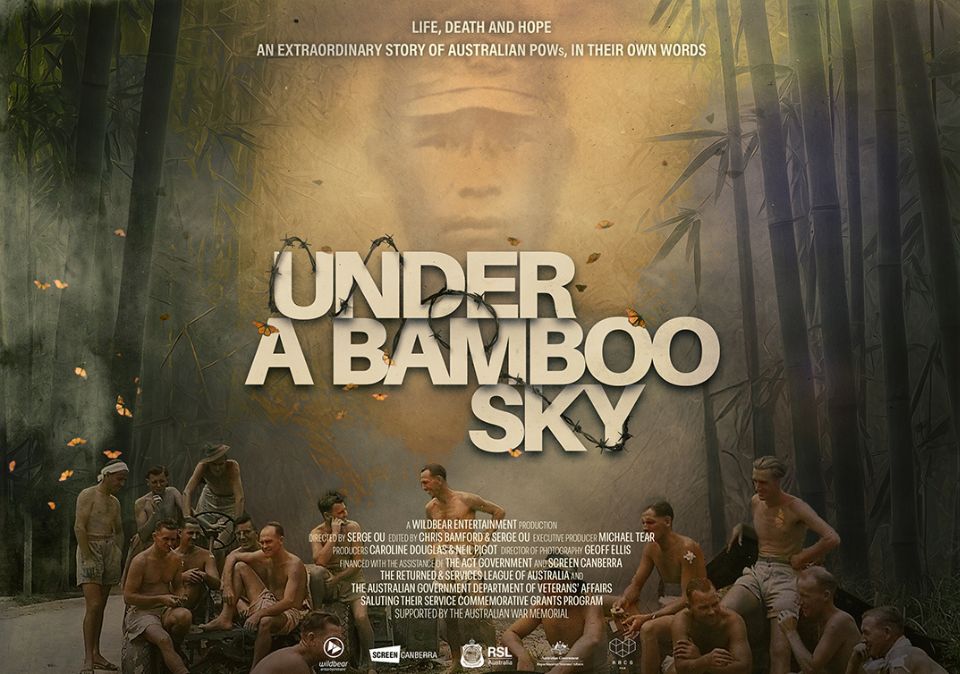
M, 77 minutes
4 Stars
Review by © Jane Freebury
If these difficult times are any guide, it is the individuals who experience the crimes against humanity that take place in war who are the most effective at communicating the experience. This intense and powerful new documentary film is an anthology of such stories, a compendium of what it was like for young Australian soldiers as prisoners-of-war in South-East and North Asia during World War II.
These are stories told in the first person, and are so telling. About what it was like being forced to build a railway through tropical jungle and massive rock embankments under appalling conditions, then shipped off to southern Japan to work in the coal mines. We hear it from men who were captured and lived to tell their tale.
Director Serge Ou and his team have woven stories of the experiences of 63 men telling it as it was. They were drawn from testimony sourced around 50 years after the end of WWII, from an archive of 2,000 veteran interviews. Some voices have not been heard before. Under a Bamboo Sky ensures that their stories of suffering and survival are now on the public record.
The men were captured in 1942 as the Japanese Imperial forces swept through Asia. They remember their time in Singapore, where they were initially held in Changi along with tens of thousands of other Allied soldiers, as relaxed to begin with. They organized concerts for their entertainment, life was laid-back and security was nowhere to be seen. In preparation for an inspection, the prisoners were handed barbed wire and told to construct a perimeter fence.
The most telling stories, told in the first person
They were left to their own devices for the first little while, until their captors realised they had a vigorous, healthy workforce at their disposal. Many Australian soldiers were country boys. Not all, though. Among the POWs was a bombardier, a certain Tom Uren, who went on to become a prominent Labor politician.
It is easy to visualise the cocky assurance among the Changi prisoners that she’d be right. Before an arduous journey by train, boat and on foot into the Thai jungle region bordering Burma (Myanmar) and the massive engineering works for a new railway that they were forced to build, swiftly put paid to this.
The men recall the many, varied challenges to their health and well-being. They were deemed fit enough to work if they could barely stand. Their rations turned strong, robust young men into living skeletons. They were brutalized for the most minor of misdemeanors and punished for their illness and incapacity. It was so horrific that some simply decided to give up and die, a more attractive option.
Beautifully balanced and remarkable record of resilience
The stories of the horrific abuse are not completely new, but some of these first-hand accounts made me gasp. The details are heart-breaking. On the other hand, the courage of the POWs, the way they cared for each other and their positive spirit are uplifting. It is a powerful statement in support of the extent to which mateship contributed to the survival of the group.
The many location shots of lush Thai jungle that have been woven into the archival record are glorious. At night, camped at the foot of bamboo some 20 or more metres high, the men looked up at a clear starry sky, kept fires going to keep the tigers (sic!) at bay and became accustomed to the strange calls of gibbon monkeys at dawn. Others recalled how beautiful the butterflies were, but how hard it was to reconcile the worst of mankind co-existing with such beauty in nature.
The plight of Allied soldiers in WWII held prisoner by Japanese Imperial forces has of course been narrated on screen from various perspectives before, in features like The Railway Man, The Bridge on the River Kwai, and the excellent recent miniseries The Narrow Road to the Deep North. These stories are difficult to tell.
Here, the veterans sent to Japan recall how beautiful the villages were with their temples and statues and how graceful bridges looked too. Moreover, the connection they made with the villagers there affirmed that it was the country’s fascistic military system that had been the real enemy.
Under A Bamboo Sky is a beautifully balanced doco. A remarkable record of resilience that lays bare the horror and hopelessness of war.
Also published in the Canberra Times 16 April 2026 and on Rotten Tomatoes