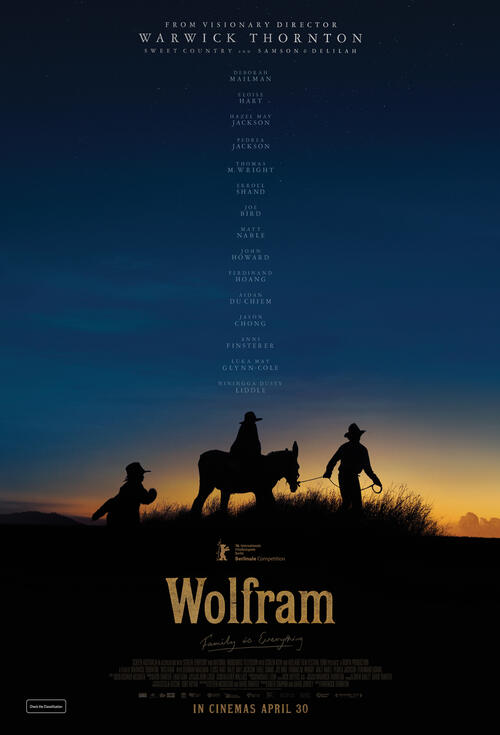
M, 100 minutes
4 Stars
Review by © Jane Freebury
While this outback drama is one of a growing number of stories on screen about Indigenous dispossession, it is also a tale of hope. This is another chapter in the history of the ‘stolen generations’, a story that does not generally deliver uplift, but it ends well, with a rising inflection. It’s a bold move.
There are vast tracts of country, sweet or otherwise, captured in sweeping vistas by director and cinematographer, Warwick Thornton. Back from the coast where he set his television series The Beach, he has returned to country, to his homelands again. In the Alice Springs region where the now celebrated filmmaker first became known for his first feature, Samson and Delilah, an ineffable masterpiece, back in 2009.
The wellspring of the Wolfram story belongs within the family histories of director Thornton and writer David Tranter, who collaborated on the screenplay with Steven McGregor. Members of the Thornton and Tranter families were forced to work in the wolfram (tungsten) mines that were opened on their ancestral lands early last century and reworked in the 1930s, when this film is set.
Child labour in those mines is a part of Indigenous family history in the central desert areas where the mineral is abundant. The aboriginal youngsters were slight and agile. They could scramble where adult men simply couldn’t, wriggling their way through narrow mine shafts to extract the rare mineral, critical for use in heavy machinery. Though it shouldn’t surprise us now, sadly, that forced labour occurred, who knew such exploitation existed.
a bold move, combining an outback western with a tender story of family reunion
Two of the main characters in Wolfram are aboriginal children, Max (Hazel May Jackson) and Kid (Eli Hart), who escape the mines and head off in search of their mother. Thankfully, their story leaves the mining field in the Northern Territory known as Hatches Creek early in the scheme of things, and follows Max and Kid above-ground. They are not much better off when they arrive at a property run by disturbed station-master Kennedy (Thomas M Wright), whose every second word is an obscenity, and Philomac (Pedrea Jackson), a young Indigenous man who is his biological son. The children manage to escape the perils there too, with Philomac as their guide.
Meanwhile, the mother Pansy (Deborah Mailman) is on the move too. Keeping an eye out for her 9 and 6-year-old, leaving tokens of threaded seeds on her way, in the off chance that they will discover them, and catch up with her.
Along their way there are various kindly Chinese miners who help them but the instincts of the white settlers are generally at odds with this tale of family reunion. In particular, a pair of white dudes, Casey (Errol Shand) and Frank (Joe Bird, effectively malevolent in the role), who want to take out a mining lease for themselves. In the best western tradition, they arrive in the nearby township, announcing themselves as villains who are looking for trouble. Their scenes in the local saloon looking for any excuse to display their worst instincts are particularly sharp.
the power of the land sweeps everything before it
Thornton describes Wolfram as a sequel to his outback western Sweet Country about some of those same characters a few years on, but with a marked difference in tone. It stands well on its own, though. However, the connection between characters here is random and tenuous at times, weakening the dramatic tension. On the other hand, the power of the land, the vast canvas in the background, is incontrovertible.
Wolfram is a grand sweeping picaresque, rolling out across the red earth, beneath a wide, azure sky, among the dust, stones and the snakes on the hard scrabble landscape where miners operated in Central Australia.
It belongs to the local genre we have come to know as the outback western. A genre includes some of my favourite local films, like The Proposition, Mystery Road, High Ground and The Tracker by Rolf de Heer. While the numbers of films in this space are growing slowly, it is surely a genre in which plenty more can be said.
Many filmgoers will respond to the familiar western look and feel in Wolfram of men with guns on horseback in the wide-open spaces on the borders between settler and Indigenous cultures. If the tender story of family reunion sits awkwardly sometimes with this outback western, the power of place that Warwick Thornton has a gift for projecting, sweeps everything else before it.
First published in the Canberra Times on 1 May 2026. My reviews are also published at Rotten Tomatoes