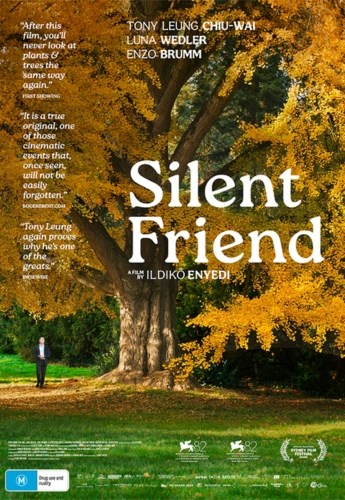
M, 147 minutes
4 Stars
Review by © Jane Freebury
Even with a couple of big names attached to this gorgeous, unusual film, we never lose sight or the sound of the natural world. It envelops us from the start. From the opening microscopic close-up of a gingko seed bursting out of its casing, to the final credits in which all the trees and plants that have made an appearance take a bow. Loosely structured with a visual artist’s eye, this film wraps itself around you like the 3D experience taking place at the IMAX next door.
Celebrated Hong Kong actor Tony Leung Chiu-wai has the main billing here, as a neuroscientist, a gentle guy who studies babies before they acquire language. He’s fascinated with how they perceive the world, responding to it in its totality, like being high all the time. At his age, Professor Tony tells his students, he would love to return to being like that, alive and alert to everything around him.
While a visiting professor during the early months of the Covid epidemic, he becomes stranded at a German university. With time on his hands during the encroaching shutdowns, Professor Tony explores his surrounds, particularly the nearby gardens. Slowly but surely, he begins to find the giant gingko biloba tree, an ancient species that has come to signify resilience and longevity, enthralling.
Fascinated by how babies perceive the world, like being high all the time
The tree connects Tony with Alice (Lea Seydoux) who makes a brief appearance as plant botanist whose work is of interest. Their connection will ultimately have an impact on the gingko and its well-being into the future.
It is the same venerable gingko that stands in the background of a photograph that Tony finds of a young woman who was among the first female students to attend the university early in the 1900s. It was of course a very different place for women then. A place where an aspiring botanist Grete (Luna Wedler) could be subjected to scandalous sexism by a panel of aging male professors who are assessing her suitability for entry to the faculty.
The interview panel do their best to unsettle her by drawing parallels between the human reproductive system and that of plants. In distressing scenes in which the elderly profs mention vulvas, and fornication and promiscuity as they test her and unsettle her with insulting insinuations, doing their best to bring her to heel. But Grete keeps her cool.
When the ordeal is over she escapes into the nearby gardens for solace among her silent friends in nature, especially the gingko with its spreading, protective limbs. A guardian spirit. These scenes in black-and-white are, like the entire film, beautifully captured by cinematographer Gergely Palos.
Grete’s story doesn’t finish there, it continues beyond the university as she discovers other ways to connect with the natural world. It develops in parallel to Tony’s story, and is one of three, all linked by their connection to nature.
What if they are observing us as we are observing them?
The third story is set in the 1970s. A new arrival on campus, self-described farm boy Hannes (Enzo Brumm) minding his own business in a campus garden, is reproached by stern Gundula (Marlene Dulow). The research project she is working on encompasses the garden where he has made himself at home. The potted pink geranium growing on her windowsill in the dorm beyond is also part of her research. It may provide evidence that it is possible for plants and people to communicate despite there being no shared language.
Alone with the geranium while Gundula is away on holidays, Hannes does his darnedest to elicit a reaction from the plant, by over-watering it, and by determining if it can recognise when the garden gate needs to be opened. What happens is genuinely intriguing.
The episode between Hannes and the potted geranium is also comical. It would be easy to admit that from the point of view of the plant world, from on high or from down below, people can look like a funny lot. What if they are observing us as we are observing them? The film’s writer-director, Ildiko Enyedi, has a lovely touch as she explores this fascinating area.
Without compromising her thought-provoking thesis, Enyedi (whose On Body and Soul won a Golden Bear at Berlin) succeeds on many levels with a beautiful film that focusses on the natural world and the interconnectedness of species. It offers a distinctly different, and rather psychedelic experience.
Published in the Canberra Times (3 July 2026) and other Australian Community Media outlets. Also published on Rotten Tomatoes