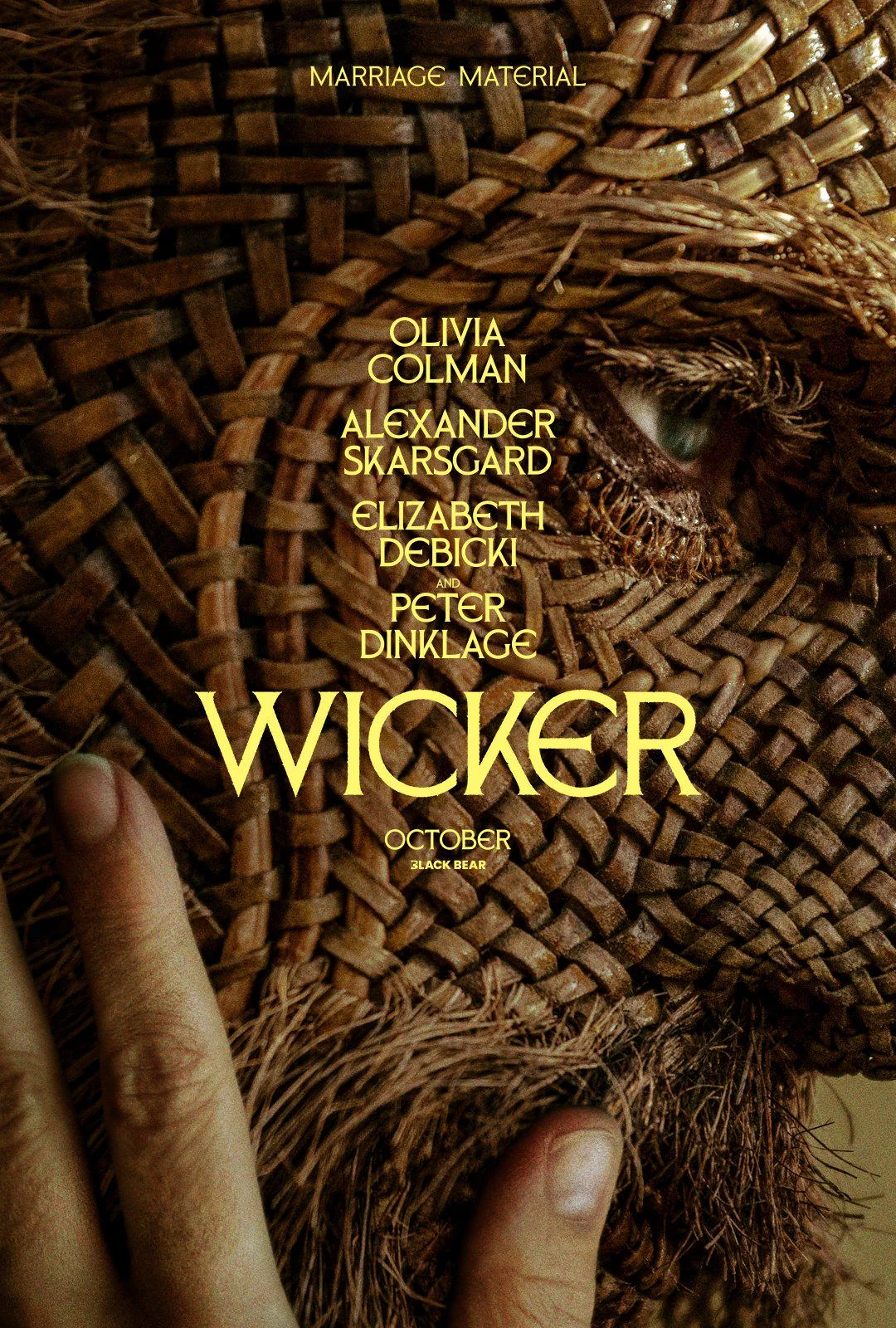
MA 15+, 106 minutes
4 stars
Review by © Jane Freebury
A romance between a soft-bodied female human and an animated wicker man had to work for this film to succeed, and it does. It works so well that this spirited dark comedy is being called raunchy, and it has earned itself an MA 15+ rating for its sex scenes. No way.
It is risqué, for sure, but we hardly need to be cautioned about the sex here. Not when extreme violence has become the new norm during the decades since censorship of screen sex and violence relaxed in the 1970s, and while the brutality has intensified it barely warrants a warning.
Loosely based on a short story, The Wicker Husband by Ursula Wills, it is the creation of writer-directors Eleanor Wilson and Alex Huston Fischer. The second feature from these filmmakers, also partners in life, who do a masterful job of combining narrative fantasy with elements that are all-too-human. It is set in a village somewhere in 17th century England.
The film is alive with sexual innuendo, a robust mix of dialogue that sometimes sounds a bit like Chaucer or a bit like Shakespeare, and a smattering of rude and quirky English idiom. Bawdy is the word for it.
Its success has a lot to do with the performance by Olivia Coleman and the terrific ensemble of character actors. Coleman brings so much, and then some, to her role as the soft-bodied woman, the lonely Fisherwoman. A social outcast, she longs for companionship but is spurned and mocked by most of the villagers. She reeks, they say, and she has got to be horny. The men and the women, led by a wonderfully snaky Elizabeth Debicki as the Tailor’s Wife, taunt her cruelly.
A lonely and lusty fisherwoman upends the goldfish bowl of village life
It all gets too much for Fisherwoman who asks the Basketmaker (Peter Dinklage) to make her a husband. He accepts the job, telling her to be at the chapel in a month. As promised, Wicker Husband, Alexander Skarsgard encased inside creaking wicker, arrives and they are married.
Creative sound design makes the most of the opportunity to relate what happens on their wedding night, most of which takes place outside the frame which is probably just as well.
Wicker Husband is also handy with a hammer and a ladder and spends his days fixing things and tending to the garden at his wife’s cottage, while she is away at work. In the still of the night, the other villagers hear their lusty lovemaking, and when the couple do a sensual dance together in the village square, there can be no doubt about what’s going on.
The good thing that Fisherwoman and her ideal husband have going stokes envy and resentment. It’s pretty galling for the men at the inn to realise that there is a bloke in their midst who shows them up for their lack of readiness to perform household tasks. For his part, the Wicker Husband simply says he simply does what he can to make his wife happy. Then reports that he’s fixed the bed, again.
Playful and bawdy, a dark comedy featuring a soft-bodied female and her wicker husband
It’s quite beyond the pale for the Tailor’s Wife who plants a seed of doubt in the mind of the Fisherwoman about her husband’s fidelity. He innocently hugged a young widow at the funeral of her husband, the Bottlewasher (Gustav Lindh). Newly married, the young Bottlewasher was the only one to try to emulate Wicker Husband’s ways. Sadly, he slipped and fell while trying to mend his roof, then eventually died at the hands of the doctor, a boofy Richard E Grant.
The Bottlewasher’s disconsolate widow (Marli Siu) visits the Basketmaker with a request of her own, for a child to keep her company. Her wish is granted, but the infant that appears is not what she had bargained for, and it prompts a series of inevitable consequences.
By the end, Wicker has had a go at the goldfish bowl of village life, with dialogue that playfully reflects the differences in gender outlook and behaviour. In other clever scenes, it mimics the differences within the romantic couple, like the literal versus the intuitive.
Wicker is wicked, with a big heart. Luck was surely with this Fisherwoman who could so easily have been denounced and tried as a witch at the time when this story is set. She simply turns the tables instead.
Published in the Canberra Times (4 November 26), and associated Australian Community Media outlets. Also published on Rotten Tomatoes