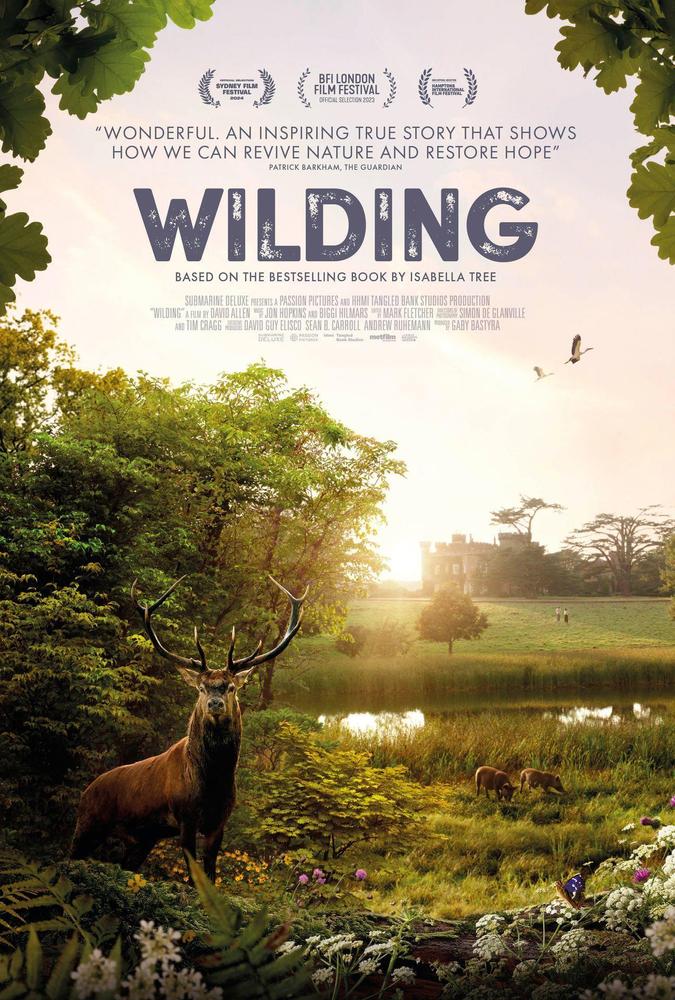
PG, 75 minutes
3 Stars
Review by © Jane Freebury
This portrait of an English couple who tried for years to maintain an inherited estate as a working farm before deciding to allow nature to take it back, is by turns quixotic and down-to-earth. It’s a surprisingly engaging and remarkable story told in a chatty, personal style that belies the significance that it holds.
It wasn’t as though Charles Burrell and Isabella Tree hadn’t given farming the estate a good go. After he inherited Knepp Estate, complete with stately castellated manor designed by Regency architect John Nash (designer of Buckingham Palace, inter alia) Charlie made a dispiriting discovery. The condition of the soil was rubbish, ‘drenched in chemicals’ by intensive farming and critically depleted of life forms and nutrients. Seventeen years of hard yakka produced only poor results.
The couple sought the advice of experts, like Dutch conservationist Frans Vera. His tip resonated. Rather than battling against nature all the time, why not let large, free-roaming animals take the lead? Over time, they would drive a new system that restored the health of the land. Wilding is as much the journey of discovery that bore this out as it is about the journey of its pigs, cows and horses who discovered their inner wild thing.
British expert on ancient trees and their ecosystems, Ted Green (actor Jon Wennington), also contributed advice on the wilding project in its the early days. With exciting word-pictures he explained what was going on beneath the grand old oaks on the estate. Under the surface there were fizzing chemicals, microbes, and fungi, all with parts to play in the survival system of these venerable trees, and they needed to be restored.
Cows, pigs and horses roam free to discover their inner wild thing
These wonderful real-life images of life forms above and below the surface, in long shot and big closeup, are the work of cinematographers Tim Cragg and Simon de Glanville. They are both celebrated nature cinematographers.
While Wilding is a testament to the wonder, power and beauty of nature, it maintains a light tone in the hands of award-winning director David Allen, steering clear of gloom and doom, maintaining positivity. The animals even contribute some comic moments.
We say that pigs can’t fly, right, but who knew they could swim? There is astonishing vision of the Tamworth pigs who were introduced onto the estate swimming and diving underwater in shallow ponds to harvest mollusc shells for food. They crunch them up and swallow them whole in an interesting take on the new word I learned here. Rootling, defined as what pigs do as they work their way through their environment.
When Isabella and Charlie supplemented their income by opening their doors to the public, there were occasions when these same pigs would crash the food marquees at polo games and gobble the food on trestle tables at the country fairs. Bold as brass. Duncan, one of the wild ponies was also badly behaved. He would crash the polo matches, bucking his way around the field to let the players know that they weren’t welcome.
Beavers have a chapter in this remarkable tale too. Isabella and Charlie sought a licence to re-introduce the animal to the wild on their estate, waiting eight years for it to be granted. Finally, they re-introduced it successfully and were able to re-establish by entirely natural means the meander of their river.
While it caused some friction, the bold environmental project far exceeded expectations
Other species, like storks and turtledoves came to stay. The density of birdsong at Knepp is now among the highest in Britain.
There are many memorable moments in this beautifully and inspirationally filmed documentary record. It is reminiscent of some of the best wildlife imagery we have seen in movies like the French nature classic Microcosmos and the current television series, A Real Bug’s Life.
Of course, there is a downside to this radical re-use of the estate. It was hard for Charlie and Isabella to keep public opinion on board as their estate changed from well-kept and tidy to wild and feral. This friction is acknowledged. The neighbours can hardly be blamed for being unhappy about the invasive and poisonous weed spores drifting across their lands. It must be an issue.
While it took time for results to show at Knepp Wildland, when they did they exceeded expectations and have garnered growing support since. The story of this bold environmental project and its implications is a revelation.
Published in the Canberra Times on 23 May 2025, and on Rotten Tomatoes