MA 15+
4 x 60 minute episodes, Stan
4 Stars
Review by © Jane Freebury
Within a few years of his experience in the armed services during World War II, a young Englishman wrote a book for a new world emerging from the devastation of war. It became one of the classics of the modern age.
The extraordinary novel, Lord of the Flies, written by William Golding while a schoolmaster, has been a set text for generations of schoolchildren since first published in 1954. Even those who missed out on it at school will be familiar with the tale of a group of British schoolboys, not yet adolescent, who survive a plane crash on a remote tropical island. In the aftermath of a cataclysmic event, they struggle to form a new society together, split into warring camps, divest themselves completely of their Christian upbringing, and have, with one or two exceptions, become savages by the time the rescuers arrive.
Later in life, Booker and Nobel-prize-winning author Golding critiqued and distanced himself from his first book, but readers have yet to put it down. This latest re-imagining, told over four episodes, has been produced by the BBC and Stan. It is immersive, as deeply troubling as ever, and a credit to its child actors, mostly non-professional.
As immersive, compelling and troubling as ever
Over four episodes, Lord of the Flies never shies away from the elements that make its disturbing narrative so compelling and the issues it raises so relevant. Why leadership is such a vexed issue, why groups choose certain personality types over others as leaders, how rituals of group behaviour form and how conformism can lead to gang violence. Questions that are as relevant today as when Golding raised them in the aftermath of a catastrophic war that exposed the violence inherent in our species.
It is difficult material. There have been notable versions at the cinema, but perhaps not as many as you might expect. This is however the first time it has been made for television, and the wider audience. Jack Thorne, who had immense success with co-writer Stephen Graham on the recent TV series Adolescence, has adapted Golding’s novel for screen. This is another story exploring the violence, typically male, inherent in our species.
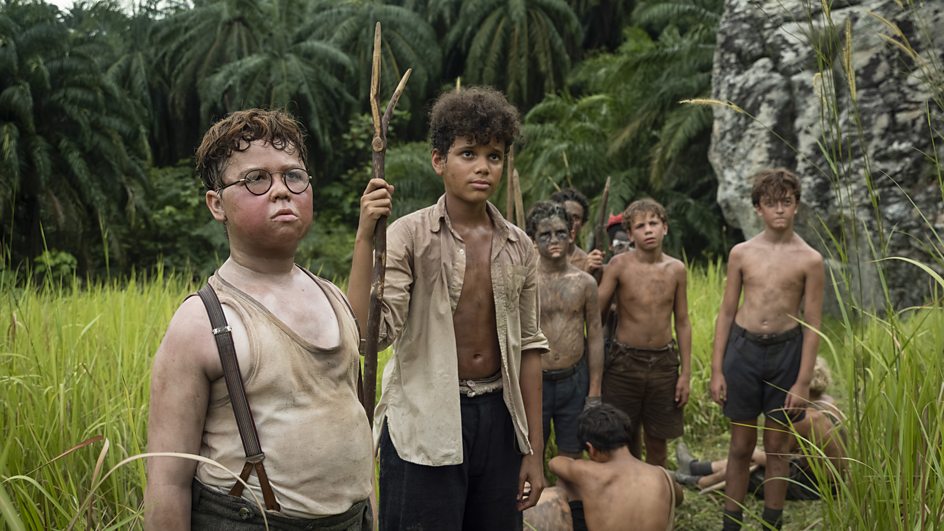
Director Marc Munden has ensured that this Lord of the Flies is robust and true to the novel’s main narrative and key themes. Significant additions include vignettes in flashback of the homelife of the older boys who dominate the story, Piggy (David McKenna), Jack (Lox Pratt), Simon (Ike Talbut gives a sensitive, nuanced performance), and Ralph (Winston Sawyers). These details give the political allegory more depth, ensuring that none of the boys, not even Jack, can be explained away simplistically.
Even Jack and his dangerous attitude cannot be explained away simplistically
From the opening scenes, the dense tropical rainforest establishes a powerful presence, beautifully framed and sometimes re-imagined, drenched in a dreamworld of colour. The primary shoot took place in Malaysia, on a tropical island not so very far from where Golding originally envisaged his allegory taking place.
The fecundity of the drooping palms, sprawling figs and mango trees heavy with fruit in a hinterland with pristine freshwater pools, and a beach fringed with mangroves, denote a perfect nature. It can meet all the boys’ needs. All they need do is get organised to manage the situation and ensure they will eventually be found.
The first episode establishes Piggy’s cred as the best suited to be the group’s brains trust, with all-rounder Ralph the ‘chief’. The second episode explores the character of their antithesis, Jack, a headstrong boy who shows early on he has a cruel streak, no patience for expert opinion or for the few organising principles initially agreed upon by the fledgling democratic society. Unfortunately, it’s Jack, of course, the lanky lad with blond hair, blue eyes and careless, dangerous attitude who attracts followers with ease. In scenes of the boys’ faces smeared in warpaint and whipped into mass hysteria, the signs of tyranny are stark.
Golding’s timeless story of children trying to establish a new society in a remote corner of the world is set in the past tense, rather than the present. It is rather surprising that it has been made as a historical, period piece. Set in the middle of last century when it was conceived, when its relevance is as contemporary and as strong as ever.
Also published in the Canberra Times on 20 February 2026, and on Rotten Tomatoes
David McKenna and Winston Sawyers (l), support cast, and Ike Talbut (r) in Lord of the Flies. Image courtesy Stan