M, 89 minutes
4 Stars
Review of © Jane Freebury
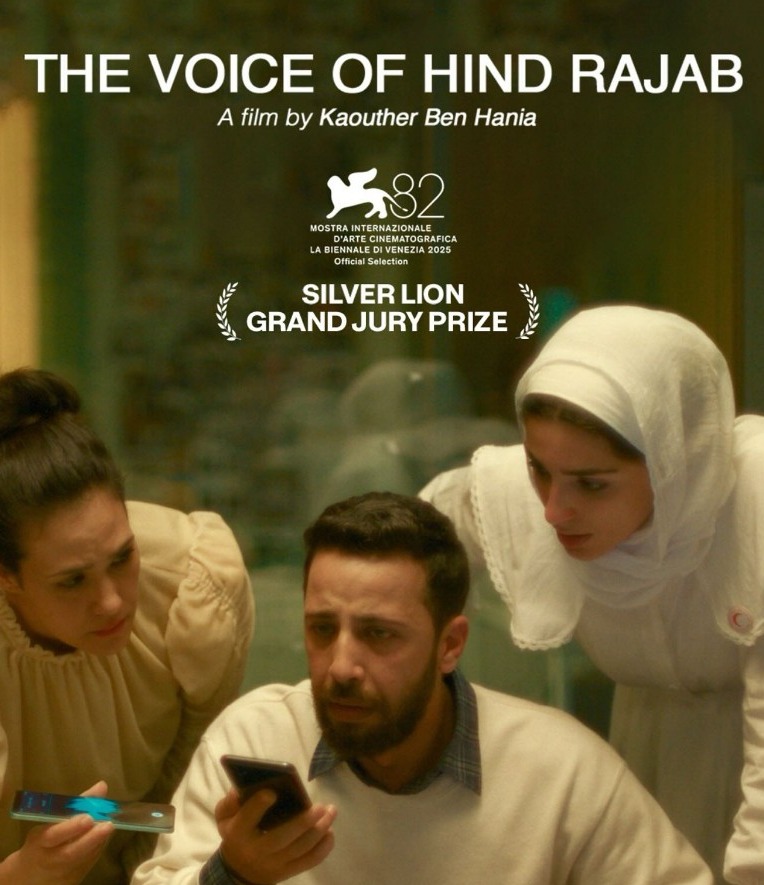
Will you come and get me? I’m on my own. A little girl asks emergency services for help while trapped in a car under fire in war-torn Gaza.
Much remains unclear about the events that led to her death in January 2024. Obfuscation initially diverted enquiries, but the ICC is looking into the incident now as a war crime, and this docudrama is Tunisia’s entry in the best international film category at the upcoming Oscars.
After orders from the Israeli Defence Force to evacuate, Hind Rajab and her uncle, aunt and four cousins, leaving the district as ordered, were killed in a hail of bullets from one or more nearby tanks. It was the middle of the day. Around 335 bullets were pumped into their car. The six-year-old was the last to succumb to the live fire. A Red Crescent ambulance despatched to rescue her was also destroyed, just metres away, its two occupants shot dead as well.
These stark facts are widely known, but will we ever hear why the car carrying the child and her uncle’s family was riddled with bullets? Why the medic and ambulance driver were killed as well. How could it ever be possible to justify such action? Who gave the orders?
There has been a continuous stream of horrifying news from Gaza for more than two years, but the focus on a child in this harrowing docudrama from Kaouther Ben Hania raises critical questions that are not asked often enough. What about the children of Gaza? Who will protect their future? Who will speak up for them?
docudrama that gives the children of Gaza a powerful voice
Beyond the statistics, the messages from Medecins Sans Frontieres, the long lines of desperate people queueing for food and water, the vision of children under-nourished and/or in urgent need of medical attention, have all become somehow normalised. The pre-eminent vision of this powerful film from Ben Hania, gives the children of Gaza their voice.
The Tunisian writer-director first sprang to notice internationally with the insights she offered in Four Daughters. Inspired was by the true story of two sisters who eloped with ISIS, it was nominated for best documentary at the Oscars two years ago.
The Voice of Hind Rajab does not attempt to re-create the horror of the events themselves visually, it uses sound instead. The experience of Hind Rajab’s last hour of life is conveyed on the audio track, by focusing on the impact of the tragedy on emergency workers taking her call. Observing how they react to Hind’s plight while trapped in a car with the bodies of her relatives, as a tank prowls the street nearby firing at signs of life in the car, is very tough indeed.
Authentic audio of Hind Rajab’s voice, a recording of around 70 minutes’ duration, is the foundation for the film. When she is on the line, the audio wave of her voice vibrates across the screen, a tiny, tenuous thread of life, while the focus rests on the emergency workers feeling impotent with frustration and despair.
during the shoot, the actors responded to Hind’s actual plea for help
The actors cast are mostly Palestinian. Omar (Motaz Malhees) and Rana (Saja Kilani) try to reassure Hind as they arrange for her rescue. Nisreen (Clara Khoury) is supervising. Amer Hlehel adds another dimension as Madi, tasked with coordination of rescue efforts through the International Red Cross. During the shoot itself, the actors were listening to the actual recording of Hind’s voice as they responded with their scripted lines. Some days on set re-inhabiting those lived moments must have been heart-wrenching.
A brief conversation is heard with Hind Rajab’s mother, who was in Germany at the time with Hind’s father and brother. It introduces some still images of a pretty girl and the life the pre-schooler once enjoyed. Hind Rajab’s family gave the project their support.
That stellar industry figures Brad Pitt, Michael Moore, Joaquin Phoenix, are Alfonso Cuaron are among the exec producers attached to this film is significant. That the director and producer of the holocaust drama The Zone of Interest are also attached means something too, for different reasons.
Around half of the population of Gaza are children. We hardly dare imagine what they have witnessed, and how traumatised they have become. Systems that should provide them with education, healthcare, nutrition, safety and a future are failing them. It doesn’t bear thinking about, though it surely does.
First published in the Canberra Times on 6 March 2026. Also published on Rotten Tomatoes