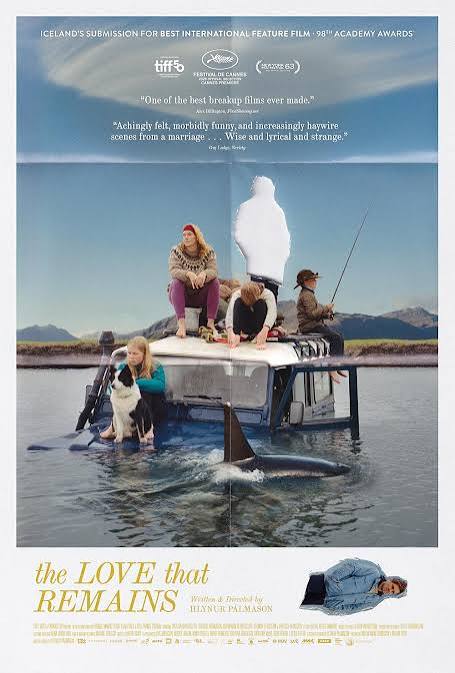
MA 15+, 109 minutes
4 Stars
Review by © Jane Freebury
It can seem that films from the island of fire and ice have more intensity than most, pitting characters against harsh nature. In this new Icelandic drama, a young family is close to nature, at one with it all. The father is a fisherman and the mother an artist who uses nature’s imprint in her work, while their three children treat the land and sea around them as a vast playground.
It’s the latest from Hlynur Palmason, the writer-director of Godland and A White, White Day, two striking and intense dramas in which nature is as beautiful as it is brutal, unrelenting and unpredictable. On this occasion, he is also cinematographer.
The Love That Remains is a conscious change in emphasis and tone from Palmason’s recent work. Something distinctly different, as he says himself. An engaging tapestry of the domestic life, recording the moments in affectionate detail, that shows how it is shared experiences within family that help the centre to hold.
Although the couple are separated, Magnus (Sverrir Gudnasson) is still close to his kids and has not yet fallen completely out of love with his former partner, Anna (Saga Garðarsdóttir). There is doubt and there is confusion, there are wistful replays of the past, and even moments when it looks like they might even hop back into bed together.
A light beguiling take on a difficult, painful subject
As one of the crew on a large commercial fishing vessel that ploughs the northern seas, Magnus is often away. But when he is back on shore, he is somehow still at sea. While welcome at the family dining table, the differences between him and Anna on parenting quickly surface.
Anna, on the other hand, is focussed intently on her artwork. Many of her ambitious installations are created out of doors, where she leaves them unprotected, inviting the forces of nature to make a contribution. The winds, the rain, the snow, the damage by the wildlife, are all part of the process.
It’s not funny for Anna, who is struggling for recognition, when horses gallop across her installations or when geese lay eggs on them either, but the film tells us it is okay for us to smile at her expense. It’s one of the ways that the filmmaker, also a visual artist, works too.
Despite her interaction with agents or gallery owners who hit on her occasionally, Anna’s working life is a solitary pursuit. On his days at sea, Magnus is isolated too, not getting much support from other members of the crew but struggling to cope.
Their children observe as their parents’ love lingers, discussing the strange behaviour when they are alone. The twin boys and older daughter are a self-contained unit out exploring rock pools at the coast, going on family hikes in the valley hinterlands, harvesting wild crowberries along the way. Panda, the pet sheepdog, tags along. Teen daughter Ida, and her younger twin brothers, Þorgils and Grimur, are played by the filmmaker’s own children.
In tune with nature, protected from a bizarre world outside
News from the outside world, with gory details of plane crashes or grisly murders or outlandish events, intrudes from time to time on television and radio. The kids chat about it together and develop their own take on it or laugh it off. A response that shows how secure they are, protected from the headwinds of a bizarre outside world. They operate as a unit in times of stress, and they are fine.
The Love That Remains, the story of a family caught up in a moment of change, is told with a beguiling light touch, and an inclination to point out the funny side of things. Not just in scenes like those of Magnus chasing an aggressive, rogue rooster that had been disturbing the hens of the coop, but scenes that depict difficult moments of anger, pain and rejection.
The languid, jazz piano of Harry Hunt in the background maintains a gentle mood, while the seasons keep rolling on, in their own rhythms of change and renewal over the course of the year in which it is set.
If we had expectations of another kind of film about family breakdown, The Love That Remains will surprise. It’s a marriage story told with subtlety and artistic flair, that also has a way of pointing out our funny side.
Published in the Canberra Times (21.8.2026), associated Australian Community Media mastheads, and at Rotten Tomatoes