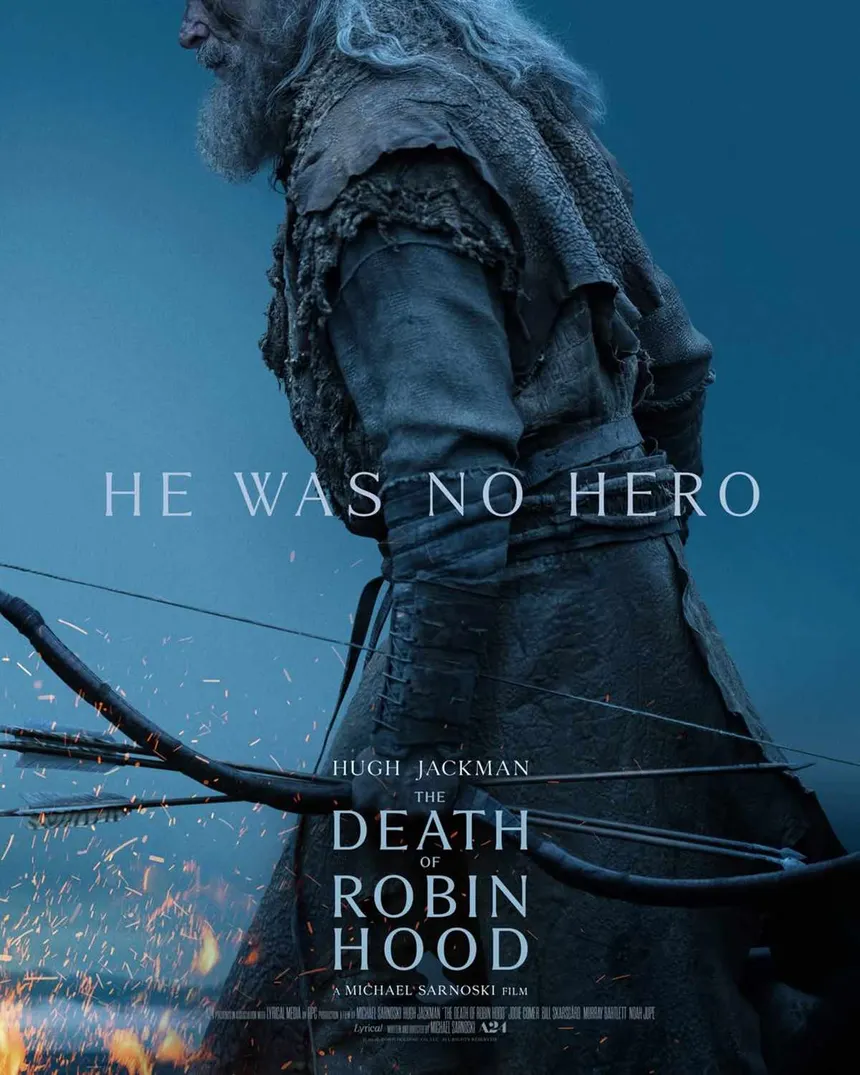
MA 15+, 123 minutes
2 Stars
Review by © Jane Freebury
Prolonged scenes of carnage at the start of this new take on the English folk hero are a radical departure from the man of myth and merrie band of outlaws who have entertained us for generations. Mercifully, the tone lifts when the gruelling violence finally stops. It’s a relief, but by then we are in no mood for derring-do.
Robin Hood (Hugh Jackman, looking wild and gaunt) has heard the news that someone mistaken for him has been hung, drawn and quartered. The famous outlaw knows that he can expect nothing less than a long and painful death himself, when he is caught.
He evades capture, but not before engaging in gruesome fights with knives and scythes, where vivid images of brutality are amplified by chilling sound. He barely escapes with his life, then lands at the door of a priory on a secluded island where nuns have the skills to restore him to health.
The Priory of Saint Clement is a place of safety as much as it is a place of healing, convalescence and palliative care. It is the sanctuary where Robin Hood will spend his last days, as his character does in the late medieval ballad on which this film by Michael Sarnoski (best known for his feature Pig, with Nicholas Cage) is based.
Under the care of Sister Brigid (an under-used Jodie Comer), Robin is restored to health, and wakes from his coma after six days. He can soon stand, walk around and take stock of his surroundings.
A killing machine in never-ending family feuds, or a drive for social equity and justice?
It has been quite the journey for the world-weary warrior who, now in late middle age, looks back on a life that he finds hard to come to terms with. Marked by endless cycles of violence, in which retribution and payback continue down through the generations.
Okay, so we have an apex fighter, but what of the prince of thieves? The legend of Robin Hood celebrates a brazen thief who robbed the rich to give to the poor. A form of wealth distribution that may have as much attraction today, as the wealth gap widens to a chasm, as it did to the peasants and yeomen of the 13th century. Whether Robin Hood ever existed or not, he embodied an impulse for social justice and equity. After all, the English peasants did revolt in the 13th century too.
At the priory, Robin fashions a long bow and some arrows to hunt rabbits, to do his bit for the priory community. He finds he shares the space with a gentle leper (Murray Bartlett), who shows him the priory gardens under cultivation with trees and plants that will become the newcomer’s responsibility once he succumbs to his disease.
Then a girl arrives at the community. Little Margaret (Faith Delaney), the orphaned child of Little John (Bill Skargard), Robin’s late, last companion in the field, will also need shelter and care. And she will need guidance on a new way forward, for a future free of the endless cycles of violent feuds that decimate families.
The concept of revenge killing and the blood feud makes some sense of the savage opening scenes. The blood feud is one of the oldest and most wretched patterns of human behaviour, and utterly self-defeating. Although clearly in evidence today.
After prolonged violence in opening scenes, it attempts a radical reset but has missed the point
The vast open spaces of moorland that writer-director Sarnoski has made Robin’s home provide nothing of the shelter and resources of a Sherwood Forest. Yet today the experts say that Robin Hood, if indeed he ever existed, probably operated in Yorkshire anyway.
However, this re-telling sidesteps the crucial point that Robin Hood was in his way, robbing the rich to give to the poor, to the disempowered. Like an impulse for social equity and the redistribution of wealth.
In Sarnoski’s film the figure of Robin Hood is a kind of killing machine who realises he should mend his ways. Redemption best summarised in a scene where he tries to dissuade young Godwyn (Noah Jupe), from carrying on with cycles of family blood feuds
From impulse for social equity to killing machine, an implacable assassin who can make no distinction between right and wrong, is a radical switch for Robin Hood. The violence is excessive and neither the writing nor the ideas behind it live up to this radical reset.
Published in the Canberra Times (19 June 2026) and associated Australian Community Media outlets. Also in Rotten Tomatoes