M, 94 minutes
4 Stars
Review by © Jane Freebury
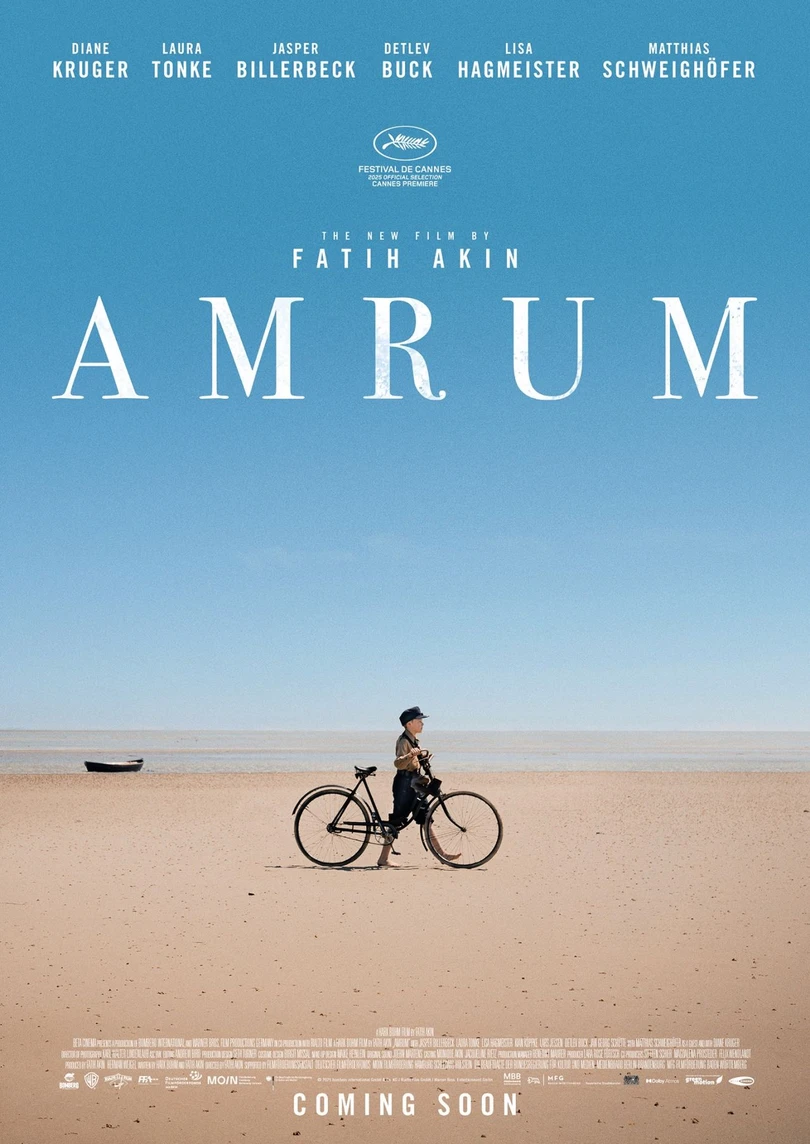
There is little sign of war on the pristine island of Amrum on the far north coast of Germany in the mid-1940s. Wide, open spaces fill the frame from the outset here. There are sprawling fields where potatoes are coaxed from the soil, and a wide sandy beach that stretches along the shore next to a shallow, sometimes treacherous, sea. The remote island is a haven for wildlife and its few inhabitants.
For them, war is happening elsewhere. The villagers manage a livelihood from the soil and the sea, and they keep their heads down. When the distinctive flag of the Third Reich appears in the frame momentarily, cutting across the sense of harmony of the natural world all around, it is a jarring reference to the horrors unfolding over the horizon. Some subsequent scenes involving portraits of the Fuhrer, and Hitler Youth paraphernalia, are jarring too.
Amrum is the latest from director Fatih Akin. Set at the end of World War II, during the last days of the Third Reich, how different it is from what we have seen from this Turkish-German filmmaker to date. It has been a collaboration between Akin and his friend and mentor, the late Hark Bohm. As a coming-of-age story by the veteran German filmmaker who grew up on Amrum, it is indeed a Hark Bohm film by Fatih Akin.
Two realities, a presence and an absence, both powerful
There are two realities here. A presence and an absence, both powerful. The pristine natural world in which we watch the drama unfold within the frame, and the horror of the well-known historical reality that lies beyond it. Occasionally the horror of war intrudes. The corpse of an airman that has washed up on the beach, the cohort of refugees that have arrived on the island, and the shortage of food. The islanders have heard that the end is not far off, with the Russian army closing in on Berlin.
The shocking truth is that the film’s 12-year-old protagonist, Nanning (Jasper Billerbeck), is the son of Nazi diehards. His father, an officer in the SS, is a prisoner of war, leaving him the eldest child in the family with responsibilities. His mother Hille (Laura Tonke) manifesting a deep depression at the death of the Fuhrer, stops eating, endangering herself and Nanning’s newly born sister.
As breadwinner, Nanning embarks on a journey to find the white bread, butter and honey that his mother craves. As he learns new life skills and makes new connections with other potential male role models among family and neighbours, he is also taking early steps towards adulthood. At the same time, making important connections with his peers within the immediate community, and perhaps even more significantly, outside it.
Aunt Ena (Lisa Hagmeister), who Hille insults for being single and childless, has her own views on the Fuhrer, thank you very much, that are similar to those of the feisty farmer (Diane Kruger) that Nanning works for. The father of Hanning’s friend Hermann (Kian Koppke) reveals a love for the American jazz and popular music that is seeping its way into the future Germany, and a scene where other villagers dance to these new world rhythms speaks a powerful truth. How opposition was already in existence and only needed the chance to express itself safely.
A young actor’s exquisitely nuanced performance
Young actor Billerbeck gives an exquisitely nuanced performance as a boy at the start of a life journey. His face registers so much expression without anything performative detracting from it. His character Nanning’s plight reminds me of the unforgettable film Lore, by Cate Shortland, about the children of Nazi parents who travel alone across a defeated Germany reeling from the collapse of its moral order.
Amrum is vastly different in scope and tone from the exciting visceral feature films like Head-On and The Edge of Heaven that first brought Akin to our attention, yet it is another exploration of aspects of German identity. The simplicity of this tale belies its power and intensity, because we recognize the difficult times that its protagonist will face into the future.
It is a timeless story, enhanced by the gorgeous cinematography of Karl Walter Lindenlaub. It suggests that innocence is never quite free of the legacy of family history, but that it is possible to face life with principled independence and a humanitarian outlook. That Hark Bohm asked his friend Fatih Akin to complete his intimate childhood story is poignant.
Published in the Canberra Times (29 May 2026) and other Australian Community Media outlets. Also on Rotten Tomatoes
Image of Jasper Billerbeck in Amrum courtesy Palace Films