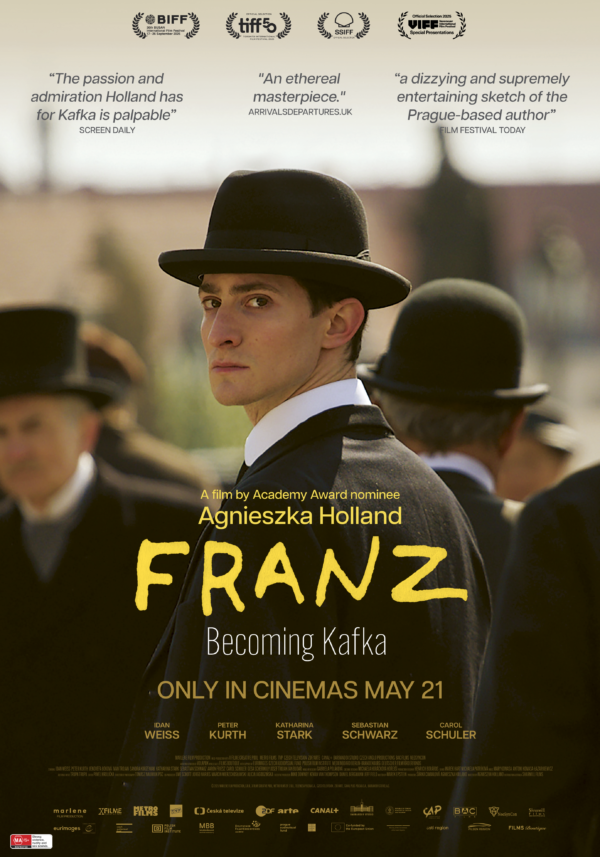
MA 15+, 128 minutes
5 Stars
Review by © Jane Freebury
A fascinating snippet we hear in this accomplished biopic is that millions of words have been written about Franz Kafka, yet his total output was relatively modest. While the contrast between the number of words that this highly influential author wrote, or what survives, and the number of words written about him, is striking, it isn’t hard to understand why the creator of strange, surrealistic works like The Metamorphosis and The Trial provokes such curiosity.
Two statues in the city of Prague celebrating the German-language writer who lived his life there, make a similar point. One features a head with sliding, rotating features. The sliding features were clearly an influence on the poster of this complex and engaging portrait of the writer from the veteran Polish filmmaker Agnieszka Holland. The other statue is a figure with an empty hollow where the head ought to be, and a male figure in a suit sitting astride its neck.
This new work from the director of Oscar-nominated films like Europa Europa, who once worked as assistant director for the legendary Andrej Wajda, sits in the tradition of European historical cinema. The director, who co-wrote the screenplay with Marek Epstein, has shown bravura skill at weaving together its disparate threads in different eras of time, from the past to the present when tourists from the world over join walking tours of the old town area to glean more about this literary hero.
Complex and skilfully woven together, from past to present
Franz is atmospheric, sometimes playfully funny and on a few other occasions horrifically brutal. It is hard not to think about the director Holland’s first-hand experience of Communist regimes in Europe during her life, with a sensibility alert to signs of repression in all its forms. It is the only way I can explain a horrifying scene of torture early on, when Franz Kafka’s readings to an audience are brought to life.
As period drama, Franz’s upbringing and his adult life in early 20th century Prague ground the biopic in meticulous historical detail. From the past, members of the Kafka family, including father, mother and sister and a dentist uncle turn to the camera occasionally to share their observations with us. It breaks the fourth wall of course, as do scenes where we join Japanese and other international tourists on Kafka walking tours in the streets of the city. It may sound like it has potential for confusion, but Holland has deftly managed the disparate threads as it plays on several levels.
From start to finish, the character Franz, who is played by Idan Weiss (who could be actor Adrien Brody’s younger brother) is unfairly put upon. Mostly by his father, Hermann, a businessman played with intimidating patriarchal intensity by Peter Kurth. You may remember him as the detective in a fedora in the television series Babylon Berlin.
A father of intimidating patriarchal intensity
Franz became an only son after the deaths of both his brothers when very young. It left him one-to-one with a domineering father with high expectations for his role in the family business. A position that Franz strove to escape, by avoiding the business and staying up late at night to write.
He did however have three sisters, who perished during the Holocaust, at Auschwitz. A tragic footnote. But during Kafka’s lifetime, Ottla (Katharina Stark) was particularly close, a steadfast friend who stood up for him when Hermann made unfair demands or thwarted the advancement of his son’s professional life in law.
And there were the women. He never married but there were affairs. The broken engagement with Felice (Carol Schuler) may make us squirm but at least Frantz behaved honestly. Even the women he visited in the brothels that he frequented could maintain their dignity in his company.
Kafka’s lifelong friendship with Max Brod (Sebastian Schwarz), the man who preserved his legacy, is also sympathetically rendered. From the scenes at the river where they rowed together to Max’s efforts to encourage his retiring friend to have confidence in his literary work, the details of their friendship are touching.
It’s worth knowing the significance of an enigmatic short scene where Max sets fire to a suitcase of Kafka’s writing, that he had been instructed to dispose of it after his friend’s death, but didn’t. It’s so cleverly handled.
Published in the Canberra Times (23 May 2026) and other Australian Community Media outlets. Also published on Rotten Tomatoes