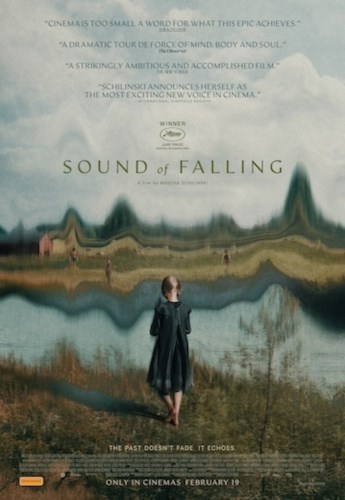
MA 15+, 149 minutes
4 Stars
Review by © Jane Freebury
Every now and then, a new film like this one set in the German countryside across generations of families, can deliver a punch. It is an impressive award-winning film. Elusive, intriguing and skilfully stitched together, while also a haunting and disturbing experience.
The River Elbe threads through Altmark, the region where the drama takes place. It could be called a rural backwater, a place to travel through without lingering, in search of the next proscribed destination elsewhere. It’s a place where archaic, even barbaric, community practices once prevailed that now live in communal memory. Newcomers to the region, like the modern-day character Christa (Luise Heyer), may wish to restore and build family life, or like the filmmakers who made Sound of Falling themselves, find inspiration for their new project there.
Writer-director Mascha Schilinksi and her collaborating writer Louise Peter spent a summer in a farmhouse in Altmark to find and develop the story for this project. It is hardly surprising to hear that the building they stayed in had been empty 50 years. No wonder there is an abundance of ghostly atmosphere on screen.
The lives of women, played out within an old farmhouse and village and fields beyond form the spine of the drama that takes place over decades. The film’s four main characters include new arrival Christa, who has settled in the village with her partner and two young daughters, Lenka (Laeni Feiseler) and Nelly (Zoe Baier) in scenes set in the 2020s.
An abundance of ghostly atmosphere in secluded countryside
In the early scenes set in the 1910s there is a large family living at the farm. From amongst them, little Alma (Hanna Heck) in blonde plaits looks out-of-frame. It’s a cool, direct look. Life on the farm among her relatives and many siblings is full, yet with time for mischief and the laughter that comes from nailing a housemaid’s shoes to the floor and watching her keel over as she steps into them again. It’s one of few humorous touches.
Death is a part of this life when Alma’s grandmother dies, as does a little boy of similar age to Alma in a neighbouring family. Yet the photographs of people taken in death with living members of family go up on the walls.
The life of Erika (Lea Drinda) set in the 1940s features in the second story of the four women. We meet her hobbling around on one leg, imitating disabled uncle Fritz (from the first story) who is confined to his bed, and ministered by the maid Trudi. Erika watches them together through the keyhole.
In the 1980s, the farmhouse is home to Erika’s sister and husband who have a teenage daughter, Angelika (Lina Urzendowsky). She is, for my money, the one most likely to survive the cycles of pain, abuse and loss that beset so many of the women.
Impact of trauma passed down through generations
Angelika’s mother survived the day local women filed into the river to drown and escape what would surely take place when enemy troops arrived after WWII. Perhaps Angelika found freedom when she disappeared from the narrative and into thin air.
The systematic abuse of women is disturbing. In synch with the moment Alma’s sister threw herself under a haycart in the earlier story, rather than work as a maid for a neighbouring family. The systemic abuse of maids that took place during the Nazi regime is horrifying.
The extent to which characters try death on for size, or commit suicide, is grim. From when Alma wears the black dress of a dead ancestor, to when it becomes clear that Irm, Erika’s sister, fails to drown herself alongside the other women during wartime, to when Angelika taunts death by laying down in a field in front of an approaching combine harvester.
As the women look out-of-frame towards us observing it is like a silent plea to bear witness. There is a smattering of voiceover but the relative absence of dialogue tilts our attention towards gesture, action and atmosphere, that is in abundance here suggesting that ghosts of the past live amongst us still.
In her statements, director Schilinski has spoken about memory of trauma being passed down through the generations. Whether there is something in the inheritance of trauma or not, prepare to be haunted by this impressive exploration of the impact of memory on the lives we live today.
Published in the Canberra Times (5 June 2026) and associated Australian Community Media, and on Rotten Tomatoes